
Perennial Percent™


The Perennial Percent™ label indicates that the product you are purchasing and enjoying was made with delicious Kernza®, the world’s first commercially available perennial grain.
Perennial grains are truly regenerative crops. The Perennial Percent™ mark empowers consumers to help farmers maintain healthy soil, prevent soil erosion, keep rivers and water clean, and enhance wildlife and biodiversity through their purchasing choices.
Bang Brewing in St. Paul, MN, launched and popularized the initiative, and baking mix and food product company Sturdiwheat in Red Wing, MN, has since adopted the program. By using the Perennial Percent™ label and making products with Kernza®, these companies and their customers are supporting the emerging market for perennial grains like Kernza® and innovating products for people to taste this sustainable ingredient.

Kernza® delivers delicious, nutty flavors to products like beer, pastries, pasta, and baking mixes.

Perennial grain farmers build healthy soil, clean water, and increased on-farm biodiversity.
Look for Perennial Percent™ labeled products to feed people and repair the planet at the same time.
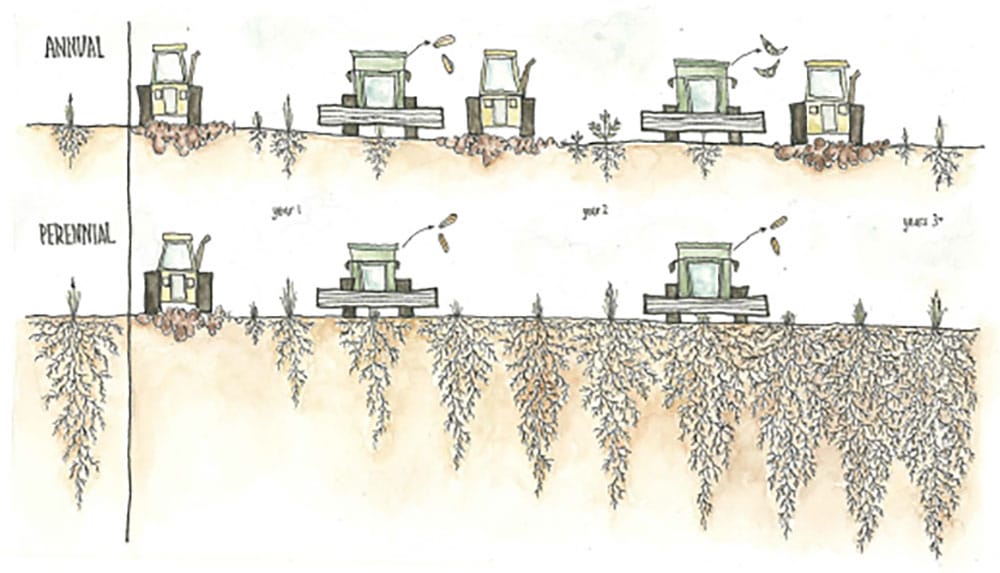
Perennial grains are new truly regenerative agricultural crops that can transform how we farm by changing what we grow. These long-lived alternatives to major grains, including cereals, legumes, and oilseeds, will allow farmers to plant once and harvest a crop for three or more years without replanting.
Because perennial grains grow long roots that extend deep into the ground, they build healthy soil, better absorb and clean water, protect soil from erosion, retain nutrients, and foster biodiversity. Kernza® (pictured left) and perennial rice are examples of new perennial grains in development at The Land Institute in Salina, Kansas, and by passionate researchers worldwide. We expect many more perennial grains to be available for farmers to grow and consumers to enjoy over the next two decades, like perennial wheat, sorghum, and pulses. We envision a future where perennial grains will form the basis of new cropping systems, like intercrops and polycultures, that can further reduce the need for inputs and enhance ecological benefits even more..


